
UV Protection in Clear Lenses
Your everyday glasses may only be doing half the job.
Most people know sunglasses block UV. Fewer know that the clear lenses they wear the rest of the day usually don’t, at least not fully. Industry standards let manufacturers claim “100% UV protection” at 380 nanometers, but the World Health Organization and most eye health authorities define the actual UV range as extending to 400 nanometers. That gap between 380 and 400nm isn’t a rounding error. It accounts for close to 40% of the UV radiation that reaches us at sea level.
The world’s most common lens material typically blocks UV only below 360nm, well short of even the outdated 380nm standard. In practice, this means roughly 4 out of 5 clear lenses sold today don’t fully protect your eyes from UV, even when the label says they do.
ZEISS UVProtect is now standard in all clear ZEISS lens materials, providing TrueUV protection for direct UV exposure.

Why this matters
UV exposure to the eyes is cumulative. It builds up over a lifetime, not just during a day at the beach. The damage isn’t limited to sunburned skin. Documented risks include cataracts, growths on the conjunctiva, corneal inflammation, and in rare cases melanoma of the iris. Children’s eyes are especially vulnerable, since their lenses are clearer and let more UV reach the retina.
Sunglasses help, but only when you’re wearing them. Studies on U.S. sunglass habits suggest only about 1 in 4 people wear them consistently outdoors. For everyone else, and for the many hours spent indoors near windows or simply not wearing sunglasses, your everyday clear lenses are doing most of the work, or not.
“But my lenses have a UV coating”
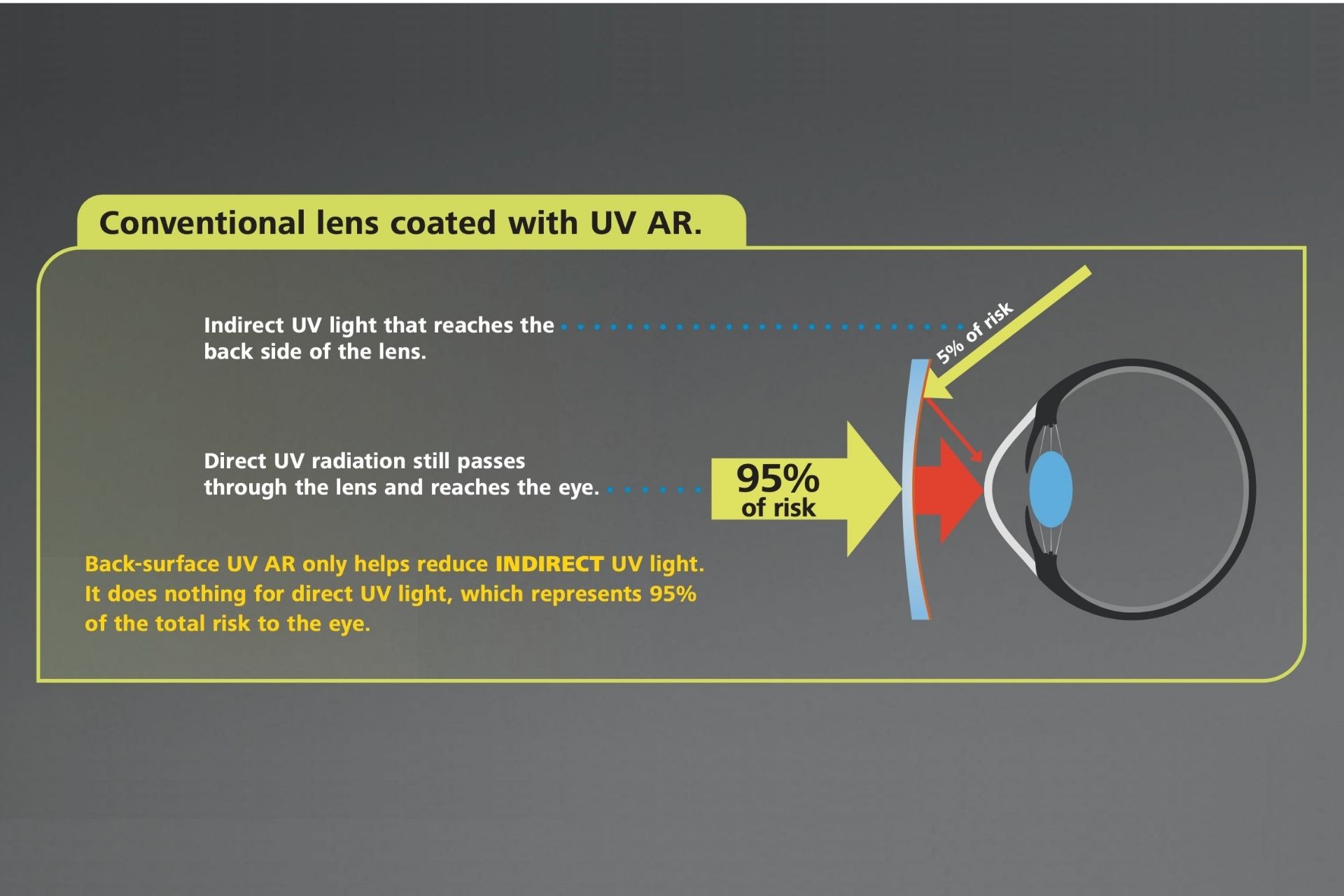
A lot of patients assume an anti-reflective coating on the back of their lenses handles UV protection. It’s a reasonable assumption, and a common one. A 2018 study published in Biomedical Optics Express measured exactly how UV radiation reaches the eye through a typical pair of glasses, and the results were clear. The vast majority of UV that reaches the eye comes straight through the front of the lens. Reflections off the back surface, the kind a back-side AR coating addresses, account for only a small fraction of total exposure.
That means a back-surface UV coating on a lens material that doesn’t itself block UV can leave the eye almost as exposed as no coating at all. Real protection has to start in the lens material.

What full UV protection looks like
ZEISS UVProtect Technology is built into the lens material itself, not added as a surface treatment. It blocks UV rays up to the full 400nm range, in every clear ZEISS plastic lens, without adding any noticeable tint. That’s the same level of protection you’d expect from a quality pair of sunglasses, available in the clear lenses you wear every day.
For patients who want the most complete coverage, pairing a UVProtect lens with a ZEISS DuraVision AR coating adds a layer of back-surface protection too, addressing both the direct UV that comes through the front of the lens and the smaller amount that can reflect off the back.
Full UV protection at Johns Creek Eyecare
UV protection isn’t something you have to remember to put on. Built into the right lens, it’s just there, all day, whether you’re driving, walking the dog, or sitting near a window at your desk.
Visit us at Johns Creek Eyecare to see whether your current lenses are giving you full UV coverage. If it’s been a while since your last pair, or if your glasses were fit under the older 380nm standard, our team can walk you through ZEISS UVProtect and get you fitted for clear lenses that protect like sunglasses, all day, every day.
